🦖 DINO: Self-supervised ViTs learn strong features and semantic structure

"Emerging Properties in Self-Supervised Vision Transformers" - Research Paper Explained
🦖 DINO: Self-supervised ViTs learn strong features and semantic structure cover

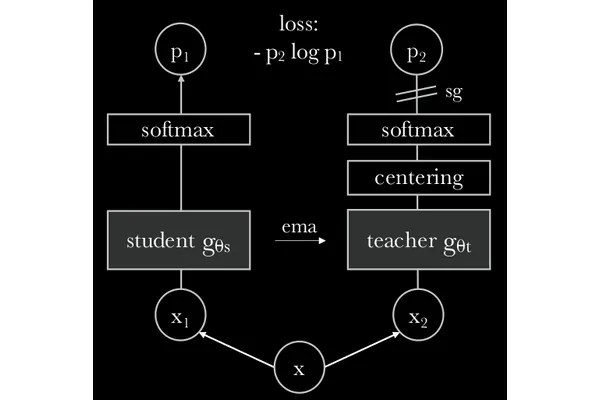
Self-distillation with no labels (DINO) trains a student network to match an exponential-moving-average teacher across differently augmented views of the same image. Applied to Vision Transformers, it produces features that perform strongly with simple linear and k-nearest-neighbor classifiers. Its final-layer self-attention also reveals object boundaries without segmentation labels, although DINO is not itself a segmentation model.

View comments.

more ...

Reinforcement learning: A practical primer on agents, returns, values, and policies

The concepts and equations needed to reason about online, offline, model-free, and model-based RL
Reinforcement learning: A practical primer on agents, returns, values, and policies cover

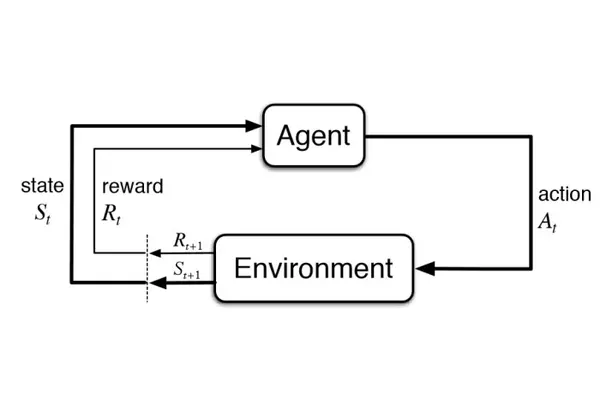
Reinforcement learning trains an agent to make sequential decisions whose consequences may arrive much later. This primer builds the essential vocabulary, derives return and value functions, explains Bellman and temporal-difference learning, and distinguishes online from offline and model-free from model-based RL.

View comments.

more ...

ERNIE 2.0: Continual multi-task pre-training for language understanding

What Baidu's 2019 framework changed, how its seven objectives work, and what its results establish
ERNIE 2.0: Continual multi-task pre-training for language understanding cover

ERNIE 2.0 extends masked-language-model pre-training with seven lexical, structural, and semantic objectives learned continually through a shared Transformer. This guide explains the training schedule, task embeddings, 2019 English and Chinese evaluations, and the limits of the reported comparison with BERT and XLNet.

View comments.

more ...

Language models: From n-gram counts to neural next-token prediction

Probability, smoothing, cross-entropy, perplexity, and the assumptions behind the numbers
Language models: From n-gram counts to neural next-token prediction cover

A language model assigns probabilities to token sequences by predicting each token from its context. This guide derives the chain rule, explains n-gram estimation and smoothing, connects cross-entropy to perplexity, and shows what changes when a neural Transformer replaces the count table.

View comments.

more ...

The Transformer – Attention is all you need.

The Transformer – Attention is all you need. cover

Transformer - more than meets the eye! Are we there yet? Well... not really, but...
How about eliminating recurrence and convolution from transduction? Sequence modeling and transduction (e.g. language modeling, machine translation) problems solutions has been dominated by RNN (especially gated RNN) or LSTM, additionally employing the attention mechanism. Main sequence transduction models are based on RNN or CNN including encoder and decoder. The new transformer architecture is claimed however, to be more parallelizable and requiring significantly less time to train, solely focusing on attention mechanisms.

View comments.

more ...

Neural Networks Primer

Neural Networks Primer cover

When you approach a new term you often find some Wiki page, Quora answers blogs and it sometimes might take some time before you find the true ground up, clear definition with meaningful example. I will put here the most intuitive explanations of basic topics. Due to extended nature of aspects and terms that are used across NN area, in this post I will place condensed definitions and a brief explanations – just to understand the intuition of terms that are mentioned in other posts along this blog.

View comments.

more ...