DINOv2: How self-supervised visual features transfer across tasks

A practical guide to "DINOv2: Learning Robust Visual Features without Supervision"
article cover

DINOv2 trains Vision Transformer encoders on 142 million curated images without using labels or captions in its pretraining objective. This guide explains how image-level self-distillation, masked patch prediction, feature-spreading regularization, data curation, and distillation combine to produce features that transfer across classification, retrieval, segmentation, and depth estimation.

View comments.

more ...

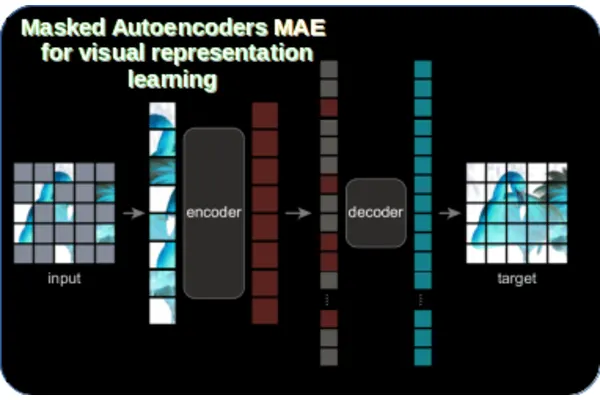
🎭 Masked autoencoder (MAE) for visual representation learning. From the author of ResNet.

"Masked Autoencoders Are Scalable Vision Learners" - Research Paper Explained
article cover

A masked autoencoder (MAE) learns visual representations by reconstructing missing image patches from a small visible subset. It divides an image into regular non-overlapping patches, samples patches uniformly without replacement, removes the masked patches before the encoder, and inserts learned mask tokens only for the lightweight decoder. With a 75% masking ratio, the encoder processes just 25% of the patches. This asymmetric design reduces training time and memory, enabling ViT-Large and ViT-Huge models to scale on ImageNet-1K. A ViT-Huge model pretrained for 1600 epochs and fine-tuned at 448-pixel resolution reaches 87.8% ImageNet-1K top-1 accuracy.

View comments.

more ...

DINO: Improving supervised ViT with richer learning signal from self-supervision

"Emerging Properties in Self-Supervised Vision Transformers" - Research Paper Explained
article cover

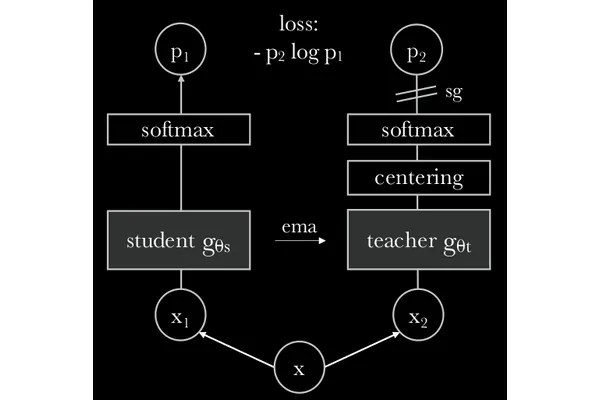
Self-DIstillation with NO labels (DINO) is a self-supervised method based on Vision Transformer (ViT) from Facebook AI with the ability to learn representation from unlabeled data. The architecture is able to learn automatically class-specific features, allowing the unsupervised object segmentation. The paper claims that the self-supervised methods adapted to ViT not only works very well, but one can also observe that the self-supervised ViT features contain explicit semantic segmentation information of an image, which is not that clear in case of supervised ViT, nor with convnets. The benefit of such observation is that such features are also very good k-NN classifiers. The performance results are reported to be highly dependent on two SSL approaches: the momentum teacher and multicrop training. In this blog post we will explain the details on what DINO is all about.

View comments.

more ...